Clinical Research
Helen & Douglas House has been involved in a number of research projects over our 40+ year history.
Helen & Douglas House has been involved in a number of research projects over our 40+ year history. These have focused on understanding and improving patient and family experience of receiving care, including pain management, support for children with feeding tubes, and spiritual care needs. We believe that our patients have an equal right to care based on the experience of their own peers. This is likely to be safer and to better meet their individual needs.
Using co-production to improve patient experience | Q Exchange
Many families now perform specialist medical procedures at home. Families need appropriate training and support to do this. The aim of this study was to evaluate a library of videos, coproduced with parents and healthcare professionals, to support and educate families caring for a child with a gastrostomy. This work is in partnership with OUHT and Oxford University. This research was was also supported by families from Helen & Douglas House and our team of doctors.
A team of parent representatives, researchers and healthcare professionals from the hospital and community have been involved in creating these videos.
Earlier in the project we did a survey with 150 families to understand their experiences of training and what types of videos would be most helpful. You may have taken part in this.
Key things we learnt from the survey:
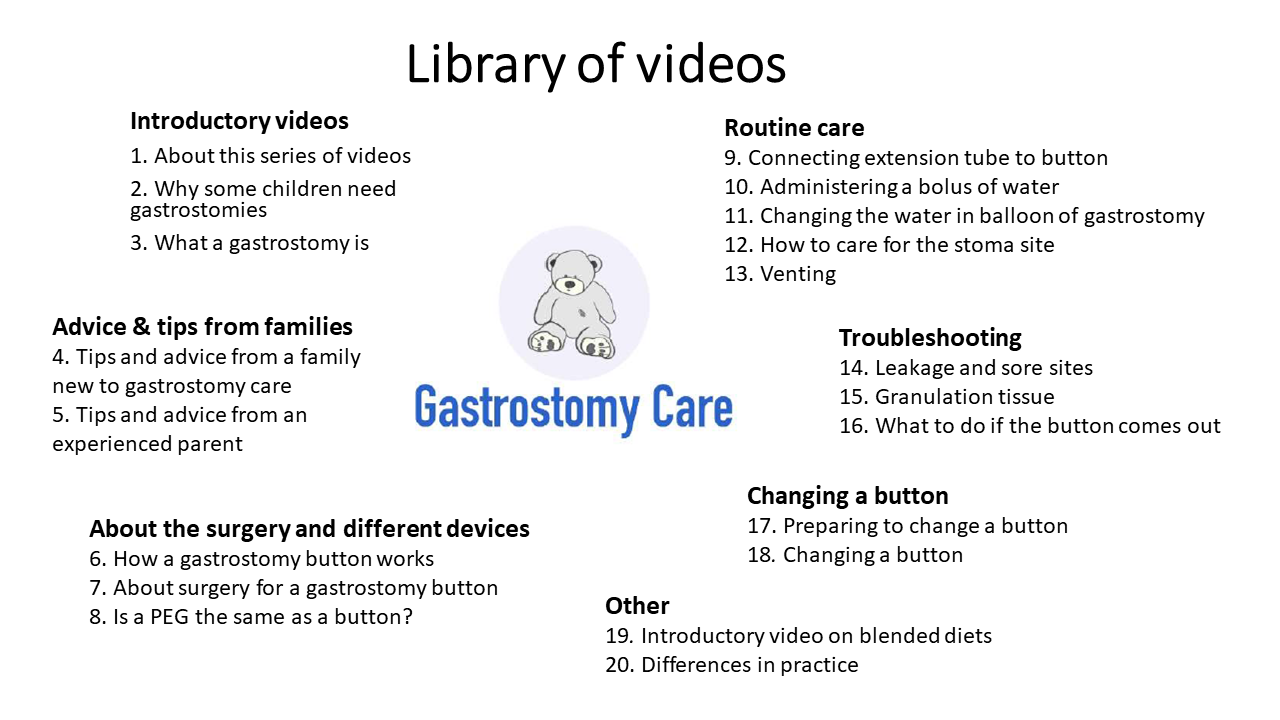 You can read more about the research itself, the evaluations and watch the videos themselves from the links on the right.
Read more- Families wanted both healthcare professionals and parents to feature and that they wanted some videos to be filmed at home and to show "real life".
- Families wanted help with managing common problems.
- Families valued advice and tips from more experienced families.
You can read more about the research itself, the evaluations and watch the videos themselves from the links on the right.
The CoPPAR Network
Addressing the current gap in quality research in paediatric palliative care requires a shared and collaborative response between the academic and paediatric palliative care sector. The aim is to provide a UK wide Collaborative Paediatric Palliative Care network that will foster and assist the sectors to work alongside one another to deliver national high-quality research studies.
The vision of CoPPAR is that it will become the single point of information for all pediatric palliative care research across the UK that can be accessed by researchers, clinicians, parents and young people, and policy makers to enable more effective and efficient delivery of research in this sector.
Read moreMedical Mediation Foundation | The True Colours Trust
Difficult decisions are often faced in clinical settings, especially where children are being treated. Sadly, in some cases, differing opinions about care or treatment can result in conflict between families and the clinicians treating their children. These conflicts can have a deep and long-lasting impact on all parties. True Colours is delighted to be working with the Medical Mediation Foundation on an exciting initiative to embed the use of conflict management and mediation skills within clinical teams.
This three-year project sees MMF working with three specialist UK hospitals to train staff in how to recognise and manage potential conflicts between families and health professionals. The hospitals involved are Leeds Children’s Hospital, Newcastle’s Great Northern Children’s Hospital and the Oxford Children’s Hospital/ Helen & Douglas House Hospice for Children.
Since April 2021, MMF have delivered 90 training session to 480 health professionals. Of these, 95% said the training was "very relevant".
Our doctors and care staff look at children's conditions and treatments as a whole, taking into account what is important for the child and the family so we can give them the best care.
Read moreChildren’s Palliative Care Outcome Scale (C-POS)
C-POS aims to develop, validate, and implement a person- and family-centred outcome measure that can be used by CYP and their families affected by LLLTC. The study will identify CYP, family, professional and commissioner priority concerns and outcomes in paediatric palliative care, which will be used to inform item generation and initial measure development.
The C-POS will be the first fully validated children and family centred outcome measure for use in paediatric palliative care. The study brings together families, researchers, health and social care professionals and champions children’s voices in the research, rather than relying on proxy data. The tool will be implemented into routine clinical practice which if used regularly to measure and document change in patient’s status, can inform and improve care for children and young people with life-limiting and life-threatening illnesses.
Read moreThe BEACON Study – Development and validation of a paediatric breakthrough pain assessment tool
This is an upcoming research study examining the best way to measure breakthrough pain in children already taking regular pain medicine. Breakthrough pain is the discomfort experienced when the symptom is temporarily worse than the existing medication can deal with and needs rapid treatment with top-up medication. Interviews will take place with young people, and their parents / carers, leading to the development of a tool, which will then be reviewed by patients, parents and healthcare professionals. The work involves several other specialist centres and is funded by Great Ormond Street Hospital Charity, and took place over an 18 month period (2022-2024).
Outcomes: Despite all efforts made, there is still no consensus on the definition of breakthrough pain. A compromise is needed on the vocabulary of breakthrough pain in order to collect reliable incidence and prevalence data.
Read moreThe SPARK Project
The SPARK Project examines the best way to deliver pastoral, spiritual and religious care to children with life limiting illnesses and their families. Helen & Douglas House were involved in recruiting families pre- and post-bereavement to take part, as well as supporting focus groups. At the moment, we know very little about how to meet the pastoral, spiritual and religious needs of children and young people diagnosed with a life-threatening or life-shortening condition, and their parents.
This study was done over 3 years from August 2020, to March 2023. The study involved focus groups and interviews with care givers, children and healthcare professionals to better understand their practices, needs and views.The aim of this study was to gather evidence the NHS and children's hospices can use to guide how they meet these needs, including the role of chaplaincy services (sometimes called pastoral and spiritual care services). It will also explore how chaplaincy services can support clinical and care teams involved in the care of these children and young people.
The conclusion from this study was that having a life-shortening or life-threatening conditions brings multiple threats to the spiritual wellbeing and lived experiences of children and young people and their families. It demonstrated the need for more training in this area particularly in the NHS. From this study, it's recognised that spirituality and spiritual care needs to be part of a child's care pathway.
Read more